

 Login / Sign Up

Blog

Can’t Stop Scrolling? Signs Your Screen Time May Be Affecting Your Focus
Have you ever opened your phone to check one notification and ended up scrolling for 30 minutes? Or sat down to work, only to find yourself checking Instagram, YouTube, or WhatsApp every few minutes?
You are not alone.
Phones, social media, streaming platforms, and endless feeds have become a normal part of everyday life. They help us stay connected, entertained, and informed. But when screen time starts taking up a large part of the day, it can affect how well we concentrate, work, study, sleep, and even relax.
The problem is not necessarily using screens. It is how much we use them, what we use them for, and whether we can put them down when we want to.
What Is Screen Time?
Screen time refers to the amount of time you spend using devices such as smartphones, tablets, laptops, televisions, and gaming consoles.
Some screen use is necessary. You may need a laptop for work, a phone for communication, or a tablet for studying. The bigger concern is often recreational screen use, especially when you keep switching between apps or scrolling without a clear purpose.
For example, checking your phone for a few minutes during a break is different from spending hours jumping between short videos, social media posts, messages, and notifications.
Over time, this constant stimulation may make it harder to stay focused on activities that require patience and sustained attention.
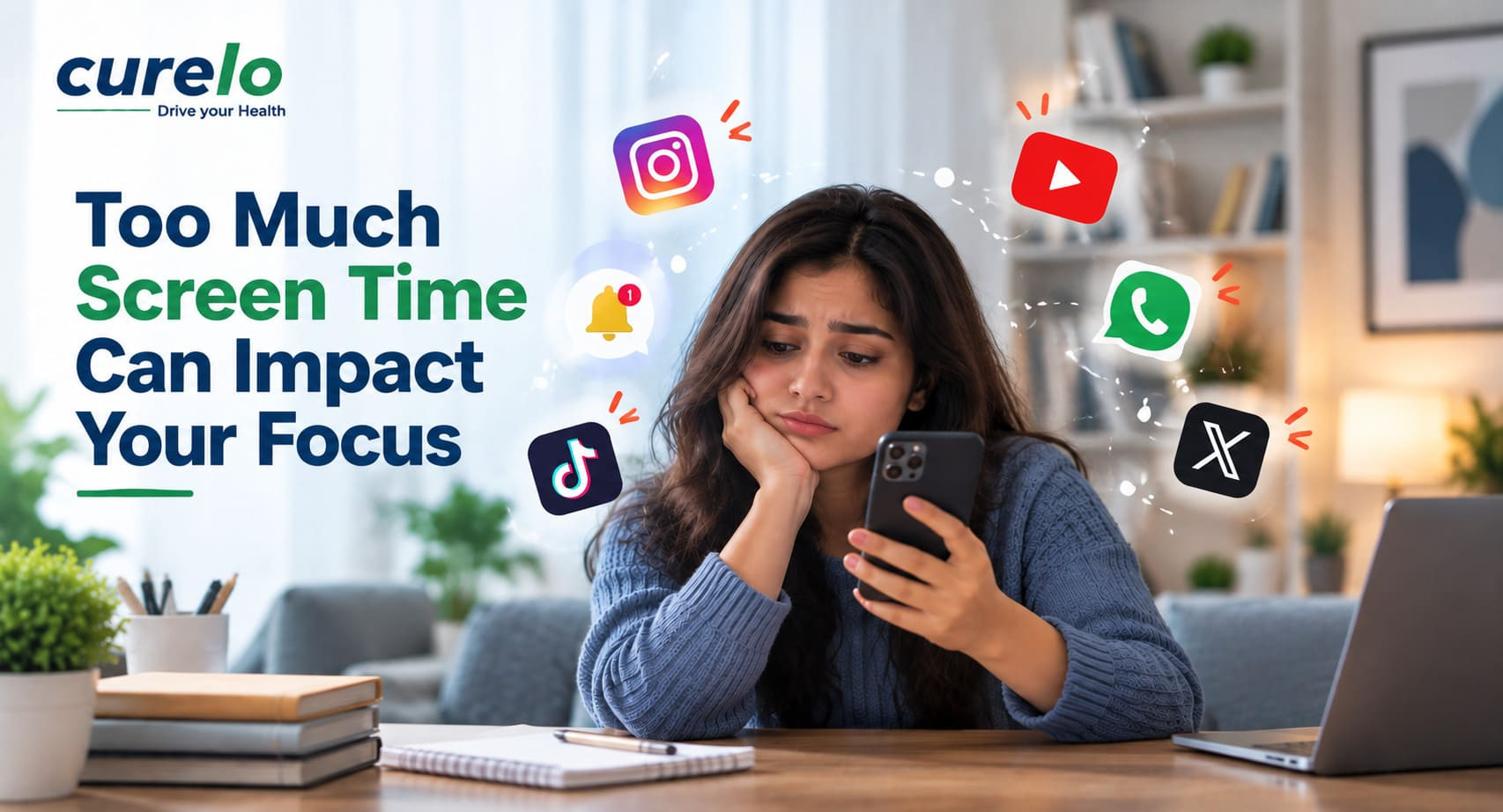
How Does Too Much Screen Time Affect Focus?
Our brains are constantly responding to what is happening around us. When you move quickly from one video, message, notification, or post to another, your attention keeps shifting.
This does not mean that using your phone automatically damages your attention span. However, frequent interruptions and habitual checking can make it harder to stay with one task for a long period.
Some common effects of screen time may include:
- Difficulty concentrating on one task
- Frequently checking your phone while working
- Getting distracted by notifications
- Feeling restless when you are not using your phone
- Taking longer to complete simple tasks
- Finding long articles or books difficult to finish
- Losing track of time while scrolling
- Using your phone even when you planned not to
If these habits sound familiar, it may be time to look at your screen use more closely.
10 Signs Your Screen Time May Be Affecting Your Focus
1. You Check Your Phone Without Thinking
Do you unlock your phone even when there is no notification?
You may pick it up while waiting for something, during conversations, while watching TV, or even while working. Sometimes, this happens almost automatically.
This repeated checking can become a habit. Your brain begins to associate moments of boredom or silence with reaching for your phone.
2. You Struggle to Focus on One Task
You start working on something, check a message, return to the task, open another tab, check social media, and then try to remember what you were doing.
Constant switching may make it harder to maintain attention.
If you frequently feel like you are busy all day but accomplish less than expected, your digital habits could be one factor worth examining.
3. You Keep Saying, “Just Five More Minutes”
This is one of the most common signs.
You tell yourself that you will scroll for five minutes. Then another video appears. Then another post. Before you realise it, half an hour has passed.
The endless nature of social media feeds makes it easy to continue consuming content without a natural stopping point.
4. You Find Boredom Uncomfortable
Waiting for an appointment? Phone out.
Standing in a queue? Phone out.
Eating alone? Phone out.
Even short periods without stimulation may start feeling uncomfortable.
Boredom itself is not necessarily a bad thing. Your mind needs moments when it is not constantly receiving new information. If every quiet moment is filled with scrolling, you may have fewer opportunities to simply pause and let your mind rest.
5. You Find It Difficult to Read or Watch Something for Long
If you regularly lose interest in a book, long article, lecture, or movie and feel the urge to check your phone, your attention habits may have changed.
Short-form content trains you to expect new information quickly. Longer activities naturally move at a slower pace.
That does not mean you have “lost” your attention span. It may simply mean that your brain has become used to frequent stimulation.
6. Notifications Break Your Concentration
A single notification can pull your attention away from what you are doing.
Even if you do not respond immediately, you may start thinking about the message. Once you check it, you might open another app and get distracted again.
Turning off unnecessary notifications can be a simple way to reduce these interruptions.
7. You Scroll When You Are Stressed
Sometimes, scrolling becomes a way to escape uncomfortable feelings.
You may reach for your phone when you are stressed, lonely, bored, tired, or anxious. The content provides a quick distraction.
There is nothing wrong with wanting a break. However, if scrolling becomes your main way of dealing with difficult emotions, it can become a difficult habit to control.
8. You Lose Track of Time Online
You intended to watch one video but ended up scrolling for an hour.
You planned to sleep at 11 PM but kept checking your phone until midnight.
Losing track of time regularly can be a sign that your screen habits need more boundaries.
9. You Use Your Phone During Conversations
Checking your phone while someone is speaking may seem harmless, but frequent phone use can make it harder to stay present.
If you constantly feel the need to check notifications, messages, or social media even during conversations, it may be worth creating phone-free moments.
10. You Feel Like You Cannot Stop
Perhaps the biggest warning sign is feeling that you do not have control over your screen use.
You decide to reduce your scrolling but find yourself returning to the same apps again and again.
This does not automatically mean you have an addiction. However, loss of control is a reason to take your habits seriously.
Is Social Media Addiction Affecting Your Attention?
The term social media addiction is commonly used to describe compulsive or difficult-to-control social media use.
Social media platforms are designed to keep users engaged. Notifications, recommendations, personalised feeds, likes, comments, and endless scrolling can encourage repeated checking.
For some people, this can become a cycle:
Boredom, Open social media, Get stimulation, Scroll, Lose track of time, Repeat
The more often this happens, the more automatic the behaviour can become.
If social media is interfering with your work, studies, relationships, sleep, or daily responsibilities, consider talking to a mental health professional for personalised guidance.
How to Reduce Screen Time Without Giving Up Your Phone
You do not have to stop using your phone completely. The goal is to create healthier boundaries.
Here are some practical ways to get started.
Set App Limits
Check your phone's built-in screen-time settings and identify which apps take up the most time.
Start with one or two apps instead of trying to change everything at once.
Turn Off Unnecessary Notifications
Not every notification requires your immediate attention.
Keep alerts for important calls and messages, and turn off unnecessary notifications from social media and other apps.
Keep Your Phone Away While Working
Instead of keeping your phone beside your laptop, place it in another room, drawer, or bag when possible.
Even a little physical distance can reduce the temptation to check it.
Create Phone-Free Times
Try having specific periods when you do not use your phone.
For example:
- During meals
- During conversations
- The first 30 minutes after waking up
- The last 30–60 minutes before bed
- While reading or studying
These small changes can gradually make your screen habits more intentional.
Replace Scrolling With Another Activity
Simply telling yourself “I won't scroll” may not be enough.
Have something else ready to do. Take a short walk, listen to music, read a few pages, stretch, talk to someone, or simply sit without your phone for a few minutes.
The aim is not to eliminate every moment of boredom. It is to become comfortable with it again.
Make Your Phone Less Tempting
Move social media apps away from your home screen, log out of accounts you check too often, or switch your display to grayscale if that helps you.
Small barriers can make mindless checking less automatic.
If you have been wondering how to reduce screen time, start with one habit rather than trying to change your entire routine overnight.
When Should You Seek Help?
High screen use does not automatically mean there is a serious problem.
However, consider seeking professional support if your screen habits are consistently affecting your sleep, work, studies, relationships, mood, or daily responsibilities.
It can also help to speak with a professional if you repeatedly try to cut down but cannot control your use.
Your overall health matters too. If you are concerned about symptoms, sleep problems, stress, or other health issues, consider speaking with a healthcare professional and getting appropriate guidance. Platforms such as Curelo can also help you find and book diagnostic tests when testing is recommended by a healthcare professional.
A Healthier Relationship With Your Screen Starts With Awareness
Screens are not going anywhere, and they do not need to.
The goal is not to feel guilty every time you use your phone. Instead, pay attention to why, when, and how often you use it.
Are you opening an app because you genuinely need it, or because you are bored?
Are you taking a break, or automatically scrolling?
Are you choosing to use your phone, or does your hand reach for it before you even think?
Once you become aware of these patterns, making changes becomes easier.
Start small. Put your phone away during one meal. Turn off a few notifications. Take a short walk without your phone. Set an app limit. Give yourself a few minutes of quiet every day.
Your focus does not need to return overnight. Small, consistent changes can help you build a healthier relationship with technology.
And if your screen habits are affecting your sleep, mood, work, studies, or relationships, don't ignore it. Taking care of your mental and overall health is just as important as managing your screen time.
FAQs
1. How much screen time is too much?
There is no single number that is automatically “too much” for every adult. Screen use can be necessary for work, education, communication, and other daily activities.
What matters is how screen use affects your life. If recreational screen time regularly interferes with sleep, exercise, work, studies, relationships, or responsibilities, it may be worth reducing it.
Instead of focusing only on the number of hours, look at your habits. Ask yourself whether you feel in control of your screen use and whether you can put your phone away when you need to.
2. Does too much screen time affect concentration?
Excessive or frequent recreational screen use can contribute to distraction and difficulty maintaining attention, particularly when it involves constant notifications, multitasking, and switching between apps.
If you frequently move between your phone and other tasks, you may find it harder to stay focused. Reducing interruptions, keeping your phone away while working, and taking regular breaks can help you build more focused habits.
3. How can I reduce my screen time?
Start by checking your daily screen-time report to understand where your time goes. Then choose one or two habits to change.
You could set app limits, turn off unnecessary notifications, keep your phone away during work, create phone-free meals, or avoid using your phone before bed.
Do not try to reduce your screen time drastically overnight. Small changes that you can maintain are often easier to stick with.
4. What are the effects of too much screen time?
The effects of screen time can vary from person to person. Excessive recreational use may be associated with problems such as distraction, reduced productivity, difficulty disconnecting, disrupted sleep routines, and less time for physical activity or face-to-face interaction.
The impact also depends on what you are doing on the screen. Using a phone for work is different from spending hours mindlessly scrolling through social media.
Need Help In Booking a Lab Test?
Share Your Details, We Will Call You Right Back!