


 Login / Sign Up

Health Scans & Imaging Tests

MRI
Magnetic Resonance Imaging (MRI) is an advanced diagnostic imaging test that uses a powerful magnetic field and radio waves to create detailed images of the body's internal organs, tissues, muscles, joints, brain, spine, and blood vessels. Unlike X-rays and CT scans, MRI does not use ionizing radiation, making it a safer option for many patients. Doctors commonly recommend an MRI to diagnose conditions such as brain disorders, spinal injuries, ligament tears, tumors, strokes, and joint problems. The procedure is painless, although it may take 20–60 minutes depending on the area being examined. Patients are required to remain still during the scan to ensure clear, accurate images that help doctors make informed treatment decisions.
Show less
CT Scan
A Computed Tomography (CT) Scan is an advanced imaging test that uses multiple X-ray images and computer technology to produce detailed cross-sectional images of the body's internal structures. It helps doctors quickly diagnose injuries, infections, tumors, internal bleeding, fractures, and diseases affecting organs such as the lungs, liver, kidneys, and brain. CT scans are also commonly used in emergencies due to their speed and accuracy. Depending on the condition being evaluated, a contrast dye may be administered to improve image clarity. The procedure is painless and usually completed within a few minutes, providing highly detailed images that assist in accurate diagnosis and treatment planning.
Show less
PET
A Positron Emission Tomography (PET) Scan is a specialized imaging test that helps doctors evaluate how organs and tissues are functioning by detecting metabolic activity within the body. Before the scan, a small amount of radioactive tracer is injected into the bloodstream, which highlights areas of abnormal activity. PET scans are widely used to detect and monitor cancers, assess heart function, evaluate brain disorders such as Alzheimer's disease, and measure the effectiveness of ongoing treatments. The procedure is safe, minimally invasive, and typically takes one to two hours, including preparation time. PET scans are often combined with CT scans to provide both functional and anatomical information for a more accurate diagnosis.
Show less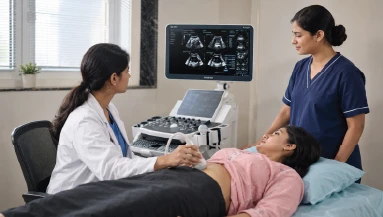
USG
Ultrasonography (USG), commonly known as an ultrasound scan, is a safe, non-invasive imaging test that uses high-frequency sound waves to create real-time images of internal organs and soft tissues. Since it does not involve radiation, it is widely used during pregnancy to monitor fetal development. USG is also commonly performed to evaluate the abdomen, liver, kidneys, gallbladder, thyroid, pelvis, blood vessels, and reproductive organs. It helps diagnose conditions such as gallstones, kidney stones, cysts, tumors, and fluid accumulation. The procedure is painless, quick, and usually completed within 15–30 minutes, making it one of the most commonly recommended diagnostic imaging tests.USG
Show less